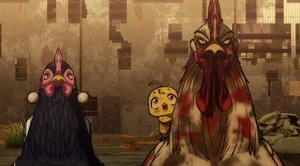
Rooster Fighter wraps up its first cour with episode 12, closing out an action-packed season that mixed absurdist chicken gags with surprisingly heavy character drama. The finale gives us the long-awaited conclusion to Hikari’s arc, delivers polished fight animation, and leaves a few major worldbuilding questions unanswered — setting up a second season while reminding viewers why this bizarre premise has become so watchable.
Episode 12 Recap: A compact, character-driven finale
The final episode largely acts as an epilogue to the warehouse arc and centers on Hikari’s tragic origin. Rather than building a grand mythological climax, the episode focuses on emotional closure — revealing the truth of Hikari’s relationship with his “demon mother” and giving the audience the backstory that explains his motivations. Battles are present but secondary to character resolution, and most of the main cast end the season reunited and intact.
Hikari’s backstory: Tragedy and blunt emotional beats
Episode 12 finally commits to showing Hikari’s history, and it’s darker than many early episodes hinted. The reveal reframes prior scenes of Hikari’s behavior and motivations, clarifying why he was willing to make extreme sacrifices. The show is blunt in its delivery: the maternal figure many assumed was a genuine parent turns out to be something far more exploitative. That emotional gut-punch works in isolation — it adds weight to the protagonist — but because it arrives in the finale, it also shortchanges time that might have been used to expand the show’s lore.
Why the timing matters
Placing this heavy backstory at the season’s end gives the moment poignancy, but it also leaves the finale feeling like an epilogue rather than a true season-closing statement. If Hikari’s trauma had appeared earlier, episode 12 could have spent more time teasing the scale of the threat to come or clarifying the nature of the devils vs. demons conflict. As-is, viewers get closure for a character while essential worldbuilding remains on the table.
Worldbuilding: What the season still hasn’t answered
Rooster Fighter hooks you with its witty premise — anthropomorphic warrior chickens fighting grotesque devils — but the series frequently holds back on explanations. The finale continues this trend: we learn about Hikari’s past, but not much about the devils’ origins, why they’re at odds with a chicken clan, or how demons differ from devils in this universe. For a show that leans satirical, some deliberate vagueness is tolerable, but a bit more upfront worldbuilding would improve investment in future stakes.
Convenient resolutions and fatigued stakes
Several plot conveniences in the latter half of the season carry into episode 12. Characters presumed gone reappear, and power developments (especially Piyoko’s hinted growth) feel suddenly accelerated without foreshadowing. Repeated near-tragic moments — designed to tug at the heartstrings — can begin to lose their impact when used frequently. The finale skirts this problem by resolving arcs gently, but it doesn’t fully fix the sense that some emotional beats were pulled for shock rather than setup.
Visuals and tone: Where Rooster Fighter excels
Despite narrative gripes, the show delivers where it matters most for fans: action choreography, stylish 3D modeling, and an unmistakable visual identity built around poultry-themed absurdity. Fight scenes remain energetic and well-staged, and the series leans into its comedy — physical gags, exaggerated gore, and soulful chicken expressions — without losing the seriousness of its dramatic moments. Small visual jokes (like the wildly inappropriate chest compressions scene) land consistently, balancing the bleak with the ridiculous.
Setting up season 2: Hints and missed opportunities
Episode 12 teases larger threats — a “final boss” stronger than anything seen so far — and confirms a second season is in development. Still, the finale could have used more time to sketch an agenda for season 2: clearer antagonists, explicit goals, or hints about the deeper history between devils and the chicken clans. That said, the tease that Keiji and Piyoko may unlock new abilities is promising and gives fans reasons to return.
How the show can improve next season
- Commit to consistent worldbuilding: answer at least a few core questions about the devils/demons conflict early.
- Space emotional reveals more evenly across episodes to avoid “crying wolf” on tragic beats.
- Continue polishing fight animation while integrating character growth visually (powers and consequences).
Where to watch
Rooster Fighter’s first season aired on Toonami and is available on streaming services. If you want to rewatch the finale or catch up on the series, check your region’s streaming platforms — for many viewers the series is available on Disney+/Hulu. Watch Rooster Fighter on Hulu. You can also look for official broadcast listings on Toonami’s site. Toonami broadcast information.
Final thoughts
Rooster Fighter’s season one is a solid, watchable experiment: it turns a bizarre premise into consistently entertaining television, thanks to confident visuals, memorable gags, and enough heart to make its darker moments hit. Episode 12 gives Hikari a satisfying personal resolution but leaves several large worldbuilding questions open — which is exciting for a second season but mildly frustrating for viewers looking for a complete arc. If the show can balance its comedy with clearer lore and pace emotional beats more deliberately, season two has the potential to elevate this quirky series into something even more memorable.
https://www.myanimeforlife.com/rooster-fighter-episode-12-review-epic-showdown/?feed_id=222579&_unique_id=6a1e90b79b4e3
Comments
Post a Comment