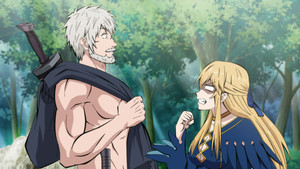
The Warrior Princess and the Barbaric King opens with a clash of expectations: a proud young knight-in-training suddenly finds herself at the mercy of a hulking “barbarian” warlord, only to discover that his world may be kinder than the one she left behind. Episodes 1–2 set up a fish-out-of-water story that leans on gender politics, cultural contrast, and tonal awkwardness—and while the series shows promise, it trips on some uncomfortable beats early on.
Episodes 1–2 — Quick Recap
Serafina (Sera) has been raised to believe that a woman’s place is limited and that her ambitions for knighthood are out of bounds. After being captured and chained by Veorg’s forces, she assumes the worst: that she will be dishonored, enslaved, or forced into pregnancy. Instead, Veorg treats her with respect and restraint, repeatedly asking for consent and treating her as a valued person rather than property. The friction between Sera’s trauma-informed assumptions and the actual behavior she experiences drives much of the first two episodes’ drama and comedy—sometimes successfully, sometimes uncomfortably.
Themes and Character Dynamics
Gender, Trauma, and Consent
One of the most striking thematic currents is how the show handles gendered expectations. Sera’s fears—born from family pressure and social conditioning—shape the way she interprets Veorg’s actions. When she assumes his intentions are predatory, that reaction is rooted in a lifetime of being told she belongs in the domestic sphere rather than on the battlefield. The series makes an effort to foreground consent: Veorg explicitly states he won’t touch her without permission and even apologizes for handling her roughly. That said, the show’s early attempts at humor around Sera’s dread (especially in episode one) can land poorly, undercutting the seriousness of her past experiences and making certain beats feel tone-deaf.
Civilization vs. “Barbarism”
Another major theme is the inversion of the “civilized vs. barbaric” trope. Sera’s homeland, ostensibly richer and more advanced, reveals itself to be more oppressive—particularly toward women—than Veorg’s so-called barbaric tribe. The barbarians’ stewardship of natural resources, respect for life, and clearer sense of consent contrast with the hypocrisy and resource-hunger of the kingdom that declared war on them. The series uses this contrast to critique what counts as true civilization and asks whether technological or institutional advancement is meaningful without ethical conduct.
Visual Style and Animation
Character Design and Line Work
Visually, the show takes stylistic risks that won’t be to everyone’s taste. Thick black outlines lend a bold, somewhat unreal look to characters and creatures alike. Sera’s musculature is an odd design choice—her abdominal definition is emphasized while other muscle groups are minimized—creating an aesthetic that can feel inconsistent. Texturing choices for monsters occasionally read like paper rather than scale, which contributes to a mixed visual identity: intriguing but uneven.
Censorship and Presentation Choices
The series also employs heavy-handed censorship in a few moments that unintentionally draw attention to themselves. Large swaths of light or glow replace details at pivotal moments, which can feel silly rather than suggestive. When a scene’s visual choices highlight what they’re hiding, it becomes a distraction; in this show's case, the “mystery” occasionally turns into an inside joke that undercuts otherwise serious character beats.
Strengths and Weaknesses
What Works
- Character contrast: The interpersonal dynamic between Sera and Veorg is compelling—their misunderstandings and gradual trust-building provide emotional momentum.
- Thematic potential: The inversion of perceived civility is an engaging narrative angle that promises deeper political and cultural exploration.
- Moments of clever detail: Props and worldbuilding (like hoof trimmers used in a humiliating yet symbolic grooming scene, or an ornamental collar that may read as status rather than bondage) add texture to the setting.
What Needs Work
- Tone management: Jokes about trauma or rape—especially when played for laughs—are risky and often land poorly; the series needs to navigate these beats more sensitively.
- Visual inconsistency: Odd design choices and conspicuous censorship can break immersion when they draw attention away from the story.
- Pacing of character reactions: Some of Sera’s shrieking and prolonged outrage feels excessive; a subtler approach could make her growth feel more earned.
Where to Watch
For viewers interested in streaming, The Warrior Princess and the Barbaric King is available on Crunchyroll. Watch on Crunchyroll.
Who Should Watch This Series?
If you enjoy fish-out-of-water tales that interrogate social norms and gender roles, this series is worth sampling. Fans of character-driven reversals—where the so-called “barbarian” proves morally superior to the established kingdom—may find the concept especially rewarding. However, viewers who are sensitive to attempts at humor involving sexual trauma or who prefer consistently polished animation may want to proceed with caution.
Final thoughts
Episodes 1–2 of The Warrior Princess and the Barbaric King introduce an intriguing premise: a young warrior forced to re-evaluate what “civilized” means when her captors show her a kinder, more respectful culture than her own. The series has promising thematic bones, especially in its critique of gender norms and colonial-style resource wars. But early tonal missteps and visual choices that sometimes call attention to themselves keep the show from reaching its full potential right away. There’s clear curiosity value here—if the production dials back the clumsy humor and leans into the political and emotional complexity, later episodes could reward patient viewers.
https://www.myanimeforlife.com/the-warrior-princess-barbaric-king-episodes-1-2-review/?feed_id=200500&_unique_id=69e142e8e41a0
Comments
Post a Comment