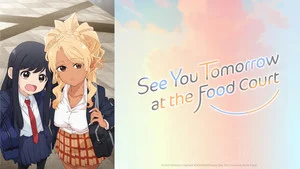
“See You Tomorrow at the Food Court” is a compact slice-of-life anime that finds charm in everyday conversation. It centers on the after-school routine of two high school girls who meet at the mall food court to unwind, snack, and talk through the small dramas of teenage life. The series doesn’t aim for grand stakes; instead, it thrives on the intimacy of repeated, familiar moments and the chemistry between its leads.
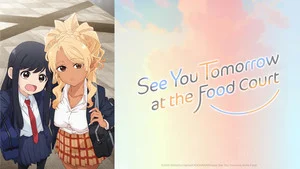
At school, Wada comes off as a quiet rich girl, while Yamamoto comes off as an intimidating Gyaru. However, it turns out that the two of them are close friends and are quite talkative together when they meet up after school at their local food court.
Synopsis — Simple premise, steady warmth
The show follows Wada and Yamamoto, two classmates who present contrasting images at school but reveal a comfortable, unguarded friendship when they meet at the food court. Episodes are structured as short vignettes representing different days at their regular table. There’s no central conflict driving a long arc — instead, the narrative momentum comes from the flow of their conversations, flashbacks to school life, and the small, recurring details tied to their meeting spot.
Why the food court setting works
Settings that replicate real, everyday hangouts have a special ability to evoke nostalgia, and this series leans into that. The food court functions as both a physical and emotional space: a neutral ground where the girls can switch off the school persona and be themselves. Because most scenes occur at the same table and location, the show relies on subtle variations in dialogue, facial expression, and camera work to keep the mood fresh. If you’ve ever cherished a consistent meet-up place with friends, the rhythm of these episodes will feel very familiar and oddly comforting.
Economy of location, richness of detail
Limiting the action to a single recurring place is a creative constraint the anime uses to emphasize character interaction over spectacle. Small visual changes — posters behind the table, background chatter, and a recurring off-screen character who’s always talked about — become tiny delights that reward attentive viewers.
Characters and chemistry — opposites that fit
The series benefits most from the lead duo’s dynamic. Wada appears outwardly conventional but is the more expressive and outspoken of the two. Yamamoto, with a gyaru aesthetic, is unexpectedly soft-spoken and often the straight woman who grounds Wada’s flights of fancy. Their banter follows a classic comedy pairing where each role can flex, but the core of the show is their easy rapport.
Relatable moments over punchlines
Not every joke lands as a belly laugh, but many scenes shift into small, quietly affecting moments: conversations about gacha pulls in mobile games, coping with awkward classmates, and chatting about one’s oshi. When the show leans into those relatable, personal topics, it reaches its most memorable beats — the ones that make you smile rather than guffaw.
Direction, visuals, and sound
Directing choices help lift a modest premise. The series uses dynamic cuts, playful framing, and expressive facial animation (especially from Wada) to keep dialogue-driven scenes visually engaging. These techniques punctuate jokes and emotional beats without needing extensive location changes. Musically, the soundtrack favors light wind instruments and flute-led background pieces meant to underscore the everyday atmosphere. While unobtrusive, the music occasionally drifts toward elevator-music territory; a bit more ambient food court noise might have enhanced the sense of place for some viewers.
Strengths and limitations — mellow charm with a modest footprint
The anime’s strengths are its comfortable tone, character chemistry, and the way it captures a universal post-school ritual. That modesty is also its weakness: by design, it doesn’t aim to stick in the memory long after you finish watching. Episodes are best enjoyed as relaxed background viewing rather than the kind of series you obsess over or rewatch for plot complexity. The show understands its niche and rarely overstays its welcome, but its mundanity means it may be eclipsed by more ambitious slice-of-life entries in the long run.
Who should watch this series?
If you enjoy character-driven slice-of-life anime with a slow, comforting pace, this show is a fine pick. Fans who appreciate subtle conversational comedy and the micro-rituals of youth will find it rewarding. If you prefer high stakes, dramatic character arcs, or bold visual experimentation, this may feel too lightweight. For viewers looking for background-friendly anime while they study, clean the house, or cook, it’s a dependable choice.
Further reading
For context on topics frequently discussed in the series, see the entries on the slice-of-life genre and gacha mechanics (external resources provided as nofollow): Slice of life (Wikipedia), Gacha (video games — Wikipedia).
Final thoughts
See You Tomorrow at the Food Court is an affectionate vignette-focused anime that excels when it leans into simple, everyday truths. It won’t redefine the slice-of-life genre, but it captures a cozy, familiar experience with warmth and a light, consistent sense of humor. If you want a short, undemanding series that feels like catching up with friends over fries and milkshakes, this one fits that niche neatly.
https://www.myanimeforlife.com/see-you-tomorrow-at-the-food-court-manga-update/?feed_id=191807&_unique_id=69c4c8b339bfb
Comments
Post a Comment