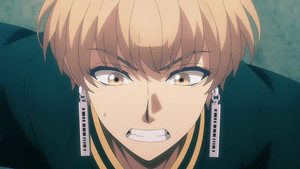
Episode 9 of Dead Account doubles down on spectacle but struggles to deliver meaningful momentum. What should have been a tense sequence of class-versus-class confrontation instead becomes a parade of stylistic missteps: awkward choreography, disruptive flashbacks, and dialogue that substitutes volume for substance. There are glimmers—most notably in the score—but they’re not enough to rescue an episode that frequently feels like it’s running out of fresh ideas.
Fights That Aim for Impact but Fall Flat
The episode opens with another classroom brawl that promises kinetic energy but largely delivers poor execution. Rather than showcasing clever choreography or stakes that build organically, fights feel like a checklist of expected beats: flashy moves, heated taunts, and pacing that jumps from frantic to stalled without reason. Punches land with hollow audio cues and animation that sometimes looks stiffer than the dialogue, which rarely gives the viewer anything beyond shouting and one-note motivations.
Kiyomi vs. Kusaba: Styling Without Substance
Kiyomi’s clash with Kusaba leans heavily on fanservice-style theatrics—complete with an over-the-top wardrobe gag—instead of emotional or tactical depth. The sequence relies on provocation rather than motivation; Kusaba’s flirtatiousness and the costume-rip moment are staged as spectacle but lack context that would make them meaningful. The combat lacks creative variety, and the sound design often undercuts any sense of physicality, making each strike feel less consequential than the show intends.
Flashbacks: Overused and Poorly Timed
One of the episode’s most consistent failures is its dependence on flashbacks that interrupt the momentum rather than enrich it. These sequences are presented with a sepia, grainy filter that suggests gravitas, but instead they read as lazy exposition. Key moments that should have been shown in real time—during training sequences or earlier episodes—are instead shoehorned in mid-fight, creating confusion and diminishing emotional payoff.
Why the Flashback Structure Fails
- Timing problems: Crucial training moments and variables in character development are revealed retroactively, often right when the stakes should be highest.
- Tone mismatch: The visual treatment of these scenes implies they’re important memories, yet they recount events that literally happened minutes beforehand.
- Interrupted pacing: Instead of advancing the present action, the flashbacks pause it, fragmenting what should be a tight, escalating confrontation.
Soji’s Power Growth: Underwhelming Payoff
The episode attempts to show Soji growing into a more formidable fighter by learning to channel his cyberkinesis outward and back inward—an idea that could have offered satisfying tactical evolution. In practice, it’s handled clumsily. The transformation essentially becomes a superficial numeric upgrade (one arm to two arms) rather than a meaningful expansion of strategy or character. When the technique finally surfaces in combat, it reads as rote escalation instead of a clever turning point.
Dei’s Character Beat Feels Tacked On
As Soji prepares to land the finishing blow, a flashback reveals Dei’s apparent thrill at being hated. This beat is meant to explain his antagonism, but it lands as a caricature—“I’m bad because I like being hated”—rather than as a layered psychological portrait. If the show wanted us to empathize or at least properly understand him, it needed to integrate these moments earlier and with more nuance.
Audio and Music: The Episode’s Best Asset
Despite narrative and animation issues, the episode’s music remains a highlight. The string arrangements and orchestral textures lend an emotional richness that the visuals sometimes lack. When the soundtrack breathes, sequences feel more dignified than they deserve, and that contrast only underscores how much stronger the series could be with more consistent creative direction.
Sound Design Problems
Unfortunately, the score is undermined by inconsistent sound design: impact tracking and effects frequently sound off, reducing the intensity of fight scenes. Where the music builds atmosphere, poorly mixed hits and awkward voice delivery pull the viewer out. An episode with tighter audio mixing might have significantly improved the overall experience.
Character Development: Stunted by Structure
Many of the episode’s characters are stuck on repeat: archetypal, reactive, and rarely afforded introspective moments that deepen audience investment. The narrative’s penchant for retroactive reveals further stalls character arcs, as motivations and consequences are explained after the fact instead of being earned in the moment. This structural choice saps tension and prevents dramatic beats from landing with authenticity.
Missed Opportunities in Supporting Cast
Side matches and smaller conflicts—like the Kasubata vs. Minoru exchange—have potential to add texture, but they too’re interrupted or undercut by ill-placed memories. These smaller fights could have been opportunities for memorable animation or smart dialogue; instead, they’re treated as filler around the main spectacle.
Streaming Availability and Where to Watch
If you want to judge the episode for yourself, Dead Account is available on major platforms. For official streaming, check Crunchyroll (rel="nofollow" target="_blank") or consult popular listings like MyAnimeList for episode guides (rel="nofollow" target="_blank").
What This Episode Means for the Season
Episode 9 signals a pattern: the series can craft moments of strong audio atmosphere and has ideas about power evolution, but it struggles with pacing, clarity, and scene composition. If future episodes reorganize exposition to show essential training and setup as they occur—rather than retrofitting them into flashbacks—the series could regain momentum. Otherwise, viewers should expect more stylistic showmanship than substantive narrative progress.
Recommendations for Improvement
- Streamline flashback usage—show rather than tell when possible.
- Refine fight choreography with clearer impact frames and more consistent sound design.
- Distribute character beats across episodes to allow emotional arcs to breathe.
Final thoughts
Episode 9 of Dead Account is an uneven installment: ambitious in sound and occasional staging, but hampered by disruptive flashbacks, stilted fights, and rushed character moments. There are sparks of quality—particularly in the score—but they’re too often smothered by execution choices that prioritize spectacle over storytelling. If the show can restrategize its approach to exposition and tighten its audio-visual presentation, it still has room to improve; as it stands, this episode is a frustrating mix of potential and squandered opportunities.
https://www.myanimeforlife.com/dead-account-episode-9-review/?feed_id=180658&_unique_id=69af056643699
Comments
Post a Comment