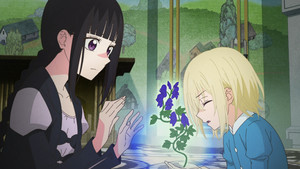
Episode 11 of Champignon Witch tightens the threads of mystery and fairy-tale symbolism, pushing characters toward difficult choices and possible redemption. This installment leans into the gray areas between "white" and "black" magic, using birds, plants, and a tower setting to raise questions about identity, belonging, and whether transformation must always be punishment. Below I break down the episode's key moments, symbolism, and what it means for the series as it heads into its final episode.
Bird Magician: A Grey Witch or Royal Confidant?
One of the most intriguing threads in Episode 11 is the Bird Magician’s ambiguous alignment. Although officially a member of the Council of Black Witches, his behavior and surroundings suggest something more nuanced. The Bird Magician maintains a tower filled with songbirds and an atmosphere distinct from the darker, more hostile spaces associated with black magic. He speaks up for Lize and appears comfortable interacting with white-aligned characters like Henri and Lize — which raises the possibility that he might be a bridge between factions, or even secretly tied to the royal family.
This ambiguity matters because it reframes how we interpret alliances in the world of Champignon Witch. If a figure on the Council of Black Witches can have white-leaning sympathies, then the straightforward division between "good" and "bad" witches becomes less reliable. That opens narrative possibilities for Lize’s path forward and suggests the series is interested in reconciliation rather than totalizing condemnation.
Plant and Bird Symbolism: Why Wolfsbane and Songbirds Matter
The episode calls attention to animals and plants as symbolic markers of morality and intent. While cats and mice carry obvious connotations — predators and pests often coded as “bad” or dangerous — birds and plants occupy a middle ground. They can be beloved (songbirds), feared (owls, ravens), or simply neutral. Wolfsbane in particular is an evocative motif: a poisonous flower that becomes an outward manifestation of Lize’s affliction.
Wolfsbane as a Narrative Device
Lize’s ability to manifest his internal poison in the form of wolfsbane ties his condition to natural, potentially redeemable elements. Plants can heal and harm; they are not morally binary. By choosing wolfsbane (and linking it visually to Luna’s red-hooded imagery), the show frames Lize’s “poison” as part of a natural cycle rather than an unequivocal evil. This supports the idea that his condition could be reversed or transformed without moral judgment.
Birds: Messengers, Witnesses, and Mediators
The Bird Magician’s tower full of songbirds also carries symbolic weight. Birds often function as messengers or symbols of freedom in fairy tales — and placing such a figure within the Council of Black Witches complicates expectations. If birds and plants are the domain of "grey" magicians, the show is hinting at an intermediate class of magic users who mediate, rather than exacerbate, conflict.
Fairy-Tale Influences: ATU 451 and Rapunzel Echoes
Champignon Witch leans on classic fairy-tale patterns to shape its emotional stakes. Episode 11 explicitly recalls elements of ATU 451, "The Brothers Who Were Turned into Birds," a tale where innocent transformations happen due to jealousy or malice and are undone by devotion. That tale type emphasizes the innocence of those transformed and the power of care to restore them — an idea that aligns with Lize’s potential redemption. (For more about tale type ATU 451, see this resource: Aarne–Thompson–Uther Index (ATU).)
Meanwhile, the tower setting and princess-coded imagery evoke Rapunzel. Lize’s princess coding, coupled with the Wind Magician’s Gothel-like threat, positions the character as someone trapped not by villainy but by others’ judgments about purity and worth. The juxtaposition of Rapunzel motifs with ATU 451’s redemption arc creates a layered fairy-tale pastiche that the show uses to ask whether transformation always equals punishment.
The Tower Scene: Power, Protection, and Perceived Ruin
The second half of the episode centers on a tense tower encounter. Henri’s tower had been described as a “safe place,” but the fact that multiple white-aligned figures know about the Bird Magician’s presence undermines the notion of secrecy. Lize’s relationship with Luna — whose protective instincts may have slowed his magical development — becomes central. The Wind Magician’s insistence that Lize is “ruined” speaks less to objective danger and more to a rigid, punitive worldview that refuses nuance.
What’s revealing is that the Wind Magician blames Lize alone, not Luna, even though Luna’s protection is part of the context. This creates moral complexity: Lize’s condition is not simply the result of his own failure, nor is Luna wholly culpable. The scene elevates Lize beyond the role of passive damsel and suggests that his agency and resourcefulness may be crucial to the series’ climax.
What Episode 11 Sets Up for the Finale
With only one episode left, Episode 11 does a lot of heavy lifting. It reframes key characters, teases the possibility of cross-faction alliances, and insists on fairy-tale motifs that favor redemption. The Bird Magician as a potential royal ally gives the story a path toward reconciliation, while Lize’s wolfsbane ability reframes his affliction as something that might be controlled or healed rather than purged.
Time is short, and not every subplot will resolve neatly. But the narrative choices in Episode 11 prioritize character growth and moral ambiguity over black-and-white outcomes, which feels thematically consistent and emotionally satisfying — provided the finale follows through on these promises.
Where to Watch
Champignon Witch is available for streaming on Crunchyroll. Watch Champignon Witch on Crunchyroll.
Final thoughts
Episode 11 of Champignon Witch smartly leverages fairy-tale motifs and symbolic worldbuilding to complicate simple moral binaries. The Bird Magician’s ambiguous status, Lize’s wolfsbane manifestation, and the tower’s Rapunzel echoes push the story toward a finale that could favor reconciliation and redemption over punishment. With its focus on gray areas, the show asks viewers to reconsider who can change and who deserves a second chance — a potent question for a series that blends magic, monarchy, and myth.
https://www.myanimeforlife.com/champignon-witch-episode-11-review/?feed_id=183589&_unique_id=69b5f62fb32ae
Comments
Post a Comment