Shanghai Licensing Firm Responds to Backlash Over Detective Conan Collaboration with Banned My Hero Academia
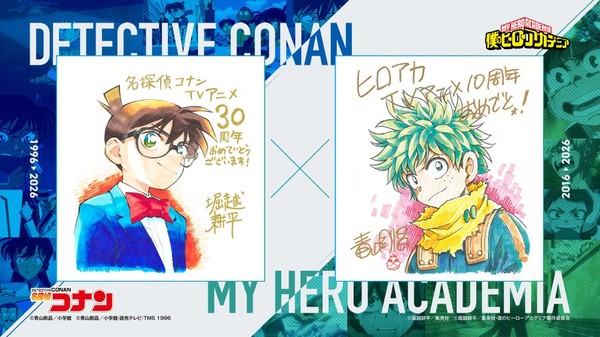
The recent illustration exchange between Gōshō Aoyama (Detective Conan) and Kōhei Horikoshi (My Hero Academia) has become one of the most talked-about crossovers in anime fandom this year — not just for the art, but for the controversy it reopened. Posted on January 31 to mark major anniversaries for both series, the collaboration is at once a warm creator-to-creator salute and a reminder of how historical sensitivities can ripple across global audiences.
The collaboration: Aoyama x Horikoshi — anniversaries and artwork
On January 31, 2026, Detective Conan creator Gōshō Aoyama and My Hero Academia author Kōhei Horikoshi exchanged commemorative illustrations to celebrate twin milestones: Detective Conan marking its 30th anniversary (the TV anime first premiered January 8, 1996) and My Hero Academia celebrating its 10th anniversary since the anime debuted in April 2016. The artwork was scheduled to appear in two major weekly manga magazines — Shueisha’s Weekly Shōnen Jump on February 16 and Shogakukan’s Weekly Shōnen Sunday on February 18 — and YTV Animation aired a short collaboration promotional video at the end of Detective Conan’s January 31 broadcast.
Why the illustration stirred controversy
Although the images themselves are a friendly exchange between two high-profile mangaka, the collaboration reopened a wound tied to a past controversy. In February 2020, My Hero Academia faced intense criticism after a villain name in chapter 259 — translated in some places as "Maruta Shiga" — was widely interpreted as referencing the Imperial Japanese Army’s Unit 731 human experimentation program. That term, "maruta," has deep, painful connotations in China and elsewhere because Unit 731 used it as a cover term for victims of atrocities during the Second Sino-Japanese War and World War II.
Historical context: Unit 731 and why the name matters
Unit 731 conducted biological and chemical warfare experiments on prisoners and civilians, including children, pregnant women, and other vulnerable people. The victims were often referred to by the dehumanizing code-name "maruta" (meaning "logs") in wartime documents and testimony. Because of that history, any casual or inadvertent use of the term in contemporary media can provoke strong backlash across East Asia and among international audiences who are aware of the atrocities.
How creators and publishers responded
Following the 2020 uproar, Kōhei Horikoshi publicly apologized and indicated he would change the character’s name. Publisher Shueisha also issued apologies and communicated in multiple languages (Japanese, English, Mandarin, Cantonese and Korean) at the time. The Shanghai Character License Administrative Company later issued a statement on January 31 clarifying that the Aoyama–Horikoshi illustration exchange was a friendly creative gesture between authors rather than a political statement, after Chinese social platforms criticized the collaboration.
What this means for crossovers in a global market
The episode highlights the complexities creators face when their work travels beyond domestic audiences. A name, visual gag, or cultural reference that feels innocuous in one market can carry historic or political weight in another. For high-profile series with significant international reach, sensitivity and awareness — along with prompt, sincere responses when mistakes happen — are essential to preserving fan relationships worldwide.
Where to see the crossover artwork and related materials
The two commemorative illustrations were shared publicly by the creators and are slated for print publication in the respective weekly magazines in mid-February. YTV Animation posted promotional material around the Detective Conan broadcast; the official post can be viewed via YTV’s X/Twitter account. For readers who want to follow primary coverage, Kyodo News reported on the collaboration and subsequent statements from Chinese licensing authorities.
Read the Kyodo News coverage (nofollow)
Beyond the headlines: what fans are saying
Reactions within the fandom have been mixed. Many fans welcomed the crossover as a celebration of two beloved series and a rare moment where creators publicly acknowledge one another. Others raised concerns based on the historical context discussed above, calling for continued sensitivity from creators and publishers. Social timelines and thread replies following the January 31 posts show both appreciation for the art and renewed debate about cultural memory in popular media.
Industry takeaways
- Creators with global platforms need heightened awareness of historical and cultural connotations behind names and references.
- Publishers should establish rapid-response channels and multilingual communications when controversies arise in different regions.
- Collaborations between major intellectual properties remain powerful promotional tools but carry reputational risk if past issues are unresolved or resurfaced.
What’s next for both franchises
Detective Conan continues to be a long-running juggernaut, celebrating its 30th anniversary in January 2026 and surpassing 1,100 TV episodes. My Hero Academia concluded its manga run in August 2024, with the final compiled volume including extra material in December 2024; the anime wrapped its eighth season with a finale on December 13, and a bonus episode based on an extra chapter is scheduled for May 2. Both properties remain highly influential: Conan with its decades-long mystery legacy, and MHA with its global blockbuster success and over 100 million manga copies in circulation as of 2024.
Final thoughts
The Aoyama–Horikoshi exchange is a layered moment: it’s a heartfelt creator tribute and a reminder of how storytelling exists within broader historical and cultural frameworks. Fans and industry alike can appreciate the artwork while also acknowledging the legitimate concerns some readers raised. The best path forward is continued dialogue, cultural awareness from creators and publishers, and thoughtful engagement from global audiences so that celebrations of beloved works can remain respectful and inclusive.
https://www.myanimeforlife.com/shanghai-licensing-firm-responds-to-backlash-over-detective-conan-collaboration-with-banned-my-hero-academia/?feed_id=164295&_unique_id=698c9381e6650
Comments
Post a Comment