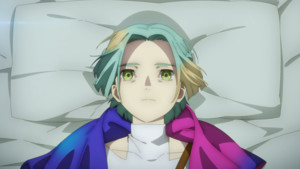
Gnosia’s midseason twists keep leaning into the show's love of puzzles and paradoxes, and episodes 16 (“Truth”) and 17 (“Bug”) together deliver a clearer — if still frustratingly tangled — picture of Yuri’s latest predicament. These two installments push forward the series’ central mystery by revealing that the Yuri we've followed may not be the original, while also expanding the emotional stakes with some surprisingly human moments. But clarity and payoff remain two different things: even when the show hands us answers, it often replaces one mystery with a dozen new questions.
Recap: Episodes 16 (“Truth”) and 17 (“Bug”)
Episode 16 opens with revelations — Yuriko provides Yuri with crucial information about the mechanics behind the Silver Key and the time-loop that keeps snapping the cast back into repeated evacuations. By the end of “Truth,” it becomes clear that the Yuri at the center of the narrative may actually be a “bug” copy: a replica displaced through time and causality rather than the original person who lived through the evacuation. Episode 17, “Bug,” follows the psychological fallout of that revelation: Bug Yuri spirals into an existential crisis and must confront what it means to be a copy with memories and desires indistinguishable from the original.
Bug Yuri Revealed: Identity, Agency, and Emotional Weight
The twist that Yuri is a “bug” rather than the original has the potential to be the season’s most emotionally resonant move. It reframes every choice and relationship: if Yuri isn’t the one who first protected Setsu, or if those memories are borrowed, what value do those actions have? “Bug” leans into that question, and although the series’ answers are predictable at times, the dialogue between Yuri and SQ stands out.
Yuri and SQ: A Rare Moment of Consistent Characterization
SQ is one of the few characters whose personality remains stable across the shifting timelines, and their exchange with Yuri about the worth of a copied life is the episode’s strongest emotional beat. It’s a straightforward sci‑fi theme — copies can be as meaningful as originals — but SQ delivers it with tenderness and clarity. In a show that often obfuscates, those small pockets of human connection matter more than they might otherwise.
Time-Loop Mechanics: Why the Plot Gets Frustrating
Where these episodes lose some viewers is in the show’s insistence on making the mechanics of its time loop both central and opaque. Gnosia frequently invites the audience to reverse-engineer its logic, but after months of puzzles this season, the payoff for that effort feels increasingly deferred. The specific “bug vs. OG Yuri” paradox illustrates why: the rules that determine when universes collapse, when duplicates can exist, and what interaction between copies triggers a catastrophic outcome are never fully explained in a way that satisfies both the brain and the heart.
Bootstrap paradox and the limits of explanation
The bootstrap-paradox framing can work when a story offers rules that feel internally consistent, but Gnosia often trades consistency for mystery. For instance, viewers are left to infer why Bug Yuri meeting Original Yuri after the pod-awakening matters so much that reality would tear itself apart. Is it atomic duplication? A metaphysical rule tied to consciousness? The series hints at these things without committing, and that half-reveal leaves some of the narrative energy exhausted on theorizing rather than being rewarded with a meaningful emotional or plot resolution.
What These Two Episodes Add to the Bigger Picture
Despite the narrative headaches, “Truth” and “Bug” are worthwhile for several reasons. First, they tighten the central conflict around the Silver Key and reveal that its purpose is more sinister and personal than we realized: it’s not just a device that traps people in a loop, but a mechanism that depends on certain interactions — specifically, Bug Yuri’s presence — to perpetuate the cycle. Second, the episodes reframe Yuri’s arc as not merely an amnesiac protagonist rediscovering facts, but as an identity crisis: if you can be copied and still feel, who are you accountable to?
That said, the reward for deciphering these episodes is largely another clue for the next episode, not a complete and satisfying answer. The information that Yuri’s injury while protecting Setsu is pivotal is important to the plot, but it feels like a small gear in a very big machine; consequential, yes, but not yet narratively cathartic.
Where to Watch
Gnosia is available to stream on Crunchyroll. For further context, the original visual novel that inspired the series offers additional lore and thematic resonance; you can find the game’s store page on Steam for background reading (both links are external and set to nofollow).
Gnosia (visual novel) on Steam
Final thoughts
Episodes 16 and 17 of Gnosia deepen the show’s core mysteries and deliver the kind of existential sci‑fi beats that can be emotionally powerful when handled with clarity. The reveal of Bug Yuri is intriguing and produces genuine character moments, particularly in the scenes with SQ. However, Gnosia’s growing reliance on convoluted time-loop mechanics and partial explanations risks alienating viewers who want payoff rather than perpetual teasing. These episodes succeed at raising stakes and sharpening questions — whether they succeed at answering them remains to be seen. For now, the series is still a rewarding watch for fans who relish puzzle-box narratives, but it’s also a test of patience for those hoping the next reveal will finally justify all the buildup.
https://www.myanimeforlife.com/gnosia-episodes-16-17-review/?feed_id=164138&_unique_id=698c50a552f84
Comments
Post a Comment