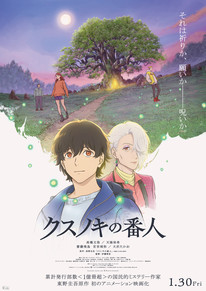
Poster: The Camphorwood Custodian
Based on Keigo Higashino's 2020 novel, The Camphorwood Custodian is a contemplative anime film that blends gentle mystery with character-driven drama. It follows Reito Naoi, a man who, after a desperate act and subsequent arrest, is released on the condition that he become the custodian of a camphorwood tree at Tsukigō shrine. What follows are interwoven vignettes—of grief, memory, class, and quiet wonder—framed around the tree's mythic presence. This review explores the film's visual strengths, its narrative choices, and the performances that carry its emotional weight.
Synopsis: a quiet setup with layered stories
Reito Naoi (voiced by Fumiya Takahashi) agrees to an unusual bargain to earn his freedom: serve as the camphorwood custodian for Chifune Yanagisawa (Yūki Amami), his estranged relative. As Reito settles into life at Tsukigō shrine, the film unfolds four concurrent stories connected by the tree's reputation for granting wishes. These threads include Reito’s own investigations into shrine rituals, the Sajis’ familial struggles, the Oba family’s strained father-son relationship, and the evolving ties between Reito and Chifune. The interplay between these narratives forms the film’s emotional core.
Visuals and art direction: Ghibli-esque vistas and whimsical establishing shots
The Camphorwood Custodian’s strongest asset is its art direction. Establishing shots of Tsukigō shrine and Tokyo brim with a soft, wistful charm reminiscent of earlier slice-of-life masterpieces. There’s a deliberate whimsy to the backgrounds that draws you into every setting—whether a misty shrine approach or a crowded Tokyo street—capturing atmosphere in a way that lingers long after scenes end. Viewers who appreciate detailed, painterly backgrounds will find much to admire here.
Animation and cinematography: moments of beauty, occasional stiffness
While the artwork is often ravishing, the animation itself is more uneven. Several sequences shimmer with fluid and imaginative movement—especially when the story leans into its more fantastical notes—but other scenes rely on static close-ups or choppy pans that can jar during emotional beats. Some camera work feels constrained, and on larger screens the occasional blown-up close-up exposes limitations in frame-by-frame animation. Still, the film compensates through composition and mood-setting: even static moments are rarely dull because of careful framing.
Music and sound design: subtle choices with an eerie undertone
The score is intentionally unobtrusive, often allowing ambient sounds and silence to do the heavy lifting. At times, this restraint creates an eerie undercurrent—especially when the camphorwood tree is onscreen—hinting at something quietly uncanny beneath the shrine’s routines. One standout musical piece is effective but arguably overused near the climax; while beautifully composed, it occasionally tells the audience what to feel instead of letting emotion arise organically. Nevertheless, the soundscape supports the film’s contemplative pace.
Performances: Yūki Amami’s commanding presence
The standout performance belongs to Yūki Amami as Chifune Yanagisawa. Amami’s delivery balances authority with subtle vulnerability, and she anchors the film with a presence that feels both formidable and human. Supporting players deliver solid work, but Amami’s voice acting steals focus in many scenes, elevating the material and giving the story a center of gravity. The cast’s restraint fits the film’s tone—few big theatrical flourishes, many quiet, lived-in choices.
Story structure and themes: interwoven tales, uneven transitions
The narrative choice to present four concurrent stories allows the film to explore the camphorwood tree from multiple angles—faith, memory, regret, and social expectation. This mosaic approach yields touching moments and meaningful resolutions, but the structure occasionally causes a disconnect when switching between threads. Some transitions demand more from the audience, asking viewers to mentally reorient and recall stakes; the payoff is often satisfying, but patience is required.
Portrayal of dementia and memory
One narrative strand addresses dementia and memory loss, which is handled with sensitivity but not exhaustive realism. The film foregrounds memory loss as emotional erosion and family strain, and while this focus yields moving scenes—especially around the Sajis—it misses opportunities to depict the broader behavioral symptoms that accompany dementia. A deeper exploration of those dynamics might have deepened both the mystery and the human stakes.
Pacing: measured, reflective, occasionally halted
Pacing leans toward the deliberate. The film is not crafted for viewers seeking continuous action; instead, it rewards those who appreciate observational cinema. That said, some narrative expositions feel too direct—there are moments where the film addresses the audience rather than letting characters discover revelations organically. Had it been a series, those beats could have breathed more easily; in a feature, they sometimes feel abrupt.
Why the film works (and where it falters)
The Camphorwood Custodian works best when relying on atmosphere, strong central performance, and the quiet dignity of its visuals. It falters when its structure interrupts immersion or when animation limitations show during intense scenes. Ultimately, the film’s emotional wins—tender character moments and satisfying resolutions—outweigh its shortcomings.
Further reading
For readers interested in the original author, Keigo Higashino’s body of work provides similar mysteries and character-focused narratives. More on the author can be found here: Keigo Higashino on Wikipedia. For context on the film’s evocative, pastoral visual influences, this overview of Studio Ghibli’s approach to environment and atmosphere is a helpful reference: Studio Ghibli.
Final thoughts
The Camphorwood Custodian is a quietly rewarding film—beautifully designed, anchored by a powerhouse performance, and thoughtful in its exploration of memory, family, and small rituals. Its narrative choices and animation inconsistencies may frustrate some viewers, but for those who enjoy contemplative, character-driven anime, this film is a memorable experience that lingers like the scent of camphorwood itself.
https://www.myanimeforlife.com/camphorwood-custodian-anime-film-review/?feed_id=173259&_unique_id=699c4449dd267
Comments
Post a Comment