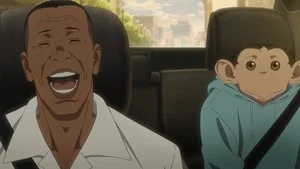
The fourth episode of The Darwin Incident digs deeper into the series' central moral question: what happens when a being who is neither fully human nor animal is forced to navigate a legal system that refuses to recognize their personhood? This installment centers on Charlie's legal status and the long shadow cast by the incident from his childhood, using courtroom pressure, social scrutiny, and a tense flashback to underscore the show's sociopolitical allegory.
Episode snapshot: rights, revelations, and restraint
Episode 4 frames most of its conflict around a single revelation: Charlie has been legally classified not as a person with constitutional protections but as property of his foster parents. His mother, a lawyer, has spent years attempting to secure basic rights for him—efforts stymied by a legal system and public discourse that treat Charlie as an anomaly rather than a subject of law. That legal impasse is the engine of the episode, prompting both procedural clashes and personal reckonings that shine a light on how society treats difference.
Legal and social allegory: when law fails people
Personhood and prejudice
The series doesn't hide its aim: the legal limbo Charlie inhabits is a metaphor for the many groups historically denied “inalienable” rights. The show places this allegory front and center, forcing viewers to confront how law and social sentiment can diverge. Charlie’s existence exposes the dangerous ease with which a community can reclassify a sentient being to avoid extending protections. It’s blunt and, at times, heavy-handed—but it lands because the real-world parallels are so familiar.
Police response and civil mechanisms
One particularly effective sequence revisits the night of Charlie’s childhood incident. What begins as typical playground bullying escalates into panic and overreaction when authorities arrive. The visuals of officers drawing weapons on a scared child crystallize the fear-driven logic behind many real incidents. The episode also nods to legal realities like civil asset seizure and bureaucratic procedures that can leave families powerless—elements that make the fiction feel uncomfortably close to home. For more context on similar legal practices, see this resource on civil asset forfeiture (external link, nofollow): Civil asset forfeiture — Wikipedia.
Character study: Charlie and the cost of isolation
Where the series often risks turning Charlie into a mere thought experiment, this episode gives him more human texture. Years of isolation have honed his intellect and logic but at the cost of social intuition. He can deduce motivations and trace actions, yet he struggles with deception, empathy in practice, and the messy give-and-take of interpersonal life. That detachment becomes his Achilles' heel: reasoning without social grounding leads to choices that backfire.
Lucy’s role: observer vs. agent
Lucy continues to function more as a tether than an active force—an audience surrogate who reacts and refracts Charlie’s growth rather than driving the plot. This can feel like a missed opportunity; if Lucy is meant to be Charlie’s humanizing influence, she needs more moments of agency and decision-making that shape the story, rather than only responding to it.
Narrative mechanics: contrivance vs. thematic payoff
The revelation that Charlie's legal non-personhood has been ongoing for years is a narrative contrivance that could have been introduced earlier. The delay feels convenient at times, yet its payoff is strong: the episode’s social commentary becomes sharper when the stakes are explicit. Some beats—like the conveniently timed discovery that makes Charlie look guilty—veer into convenient plotting, but they also underscore a central point of the series: in a system predisposed to view Charlie as less than human, guilt is assumed long before evidence is weighed.
The writing is uneven. On one hand, you get genuinely resonant scenes that explore isolation, prejudice, and the limitations of legal remedies. On the other, the script occasionally leans on culturally loaded shorthand—such as a conspicuously named “Red Pill Channel”—that reads as a blunt instrument rather than subtle social satire. Even so, the bluntness itself serves the show’s purpose: to hold a mirror up to systems that reduce personhood to checkboxes and headlines.
Direction and atmosphere
Visually, episode 4 balances quiet character moments with tense procedural sequences. The flashback sequence is staged tightly: cramped homes, anxious adults, and the stark contrast between a child’s fear and a crowd’s armed readiness create sustained discomfort. The series’ design choices—muted palettes, restrained camera work during legal scenes—help keep the focus on the ethical questions rather than spectacle.
Where to watch
The Darwin Incident is available for streaming on Prime Video. If you want to watch the legal and social dynamics discussed in this episode unfold firsthand, here's the official streaming page (external link, nofollow): Prime Video — The Darwin Incident.
Strengths and shortcomings
- Strengths: Strong allegorical core, meaningful character beats for Charlie, effective tension in flashback scenes, and a clear thematic throughline about personhood and the law.
- Shortcomings: Occasional heavy-handedness in messaging, underutilized supporting characters (especially Lucy), and some convenient plotting that stretches believability for dramatic effect.
Final thoughts
Episode 4 of The Darwin Incident is one of the series’ more thematically coherent entries—uneven in execution, perhaps, but emotionally and politically resonant. The episode succeeds when it refuses to look away from how legal systems and public fear can strip personhood from those who don’t fit neat categories. Charlie emerges less as a philosophical thought experiment and more as a person shaped by neglect, law, and a brutal necessity to prove his own humanity. If the series continues to balance its blunt allegory with sharper character work for those around Charlie, it could become a surprisingly potent critique of how societies legislate who matters.
https://www.myanimeforlife.com/the-darwin-incident-episode-4-review/?feed_id=161399&_unique_id=697c737c92891
Comments
Post a Comment