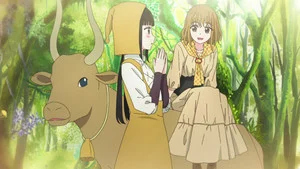
Episode 5 of Champignon Witch deepens the worldbuilding and emotional stakes of the series by revealing painful truths about how witches are classified, used, and persecuted. Through Luna’s past and the tragic death of the Cat Witch Dorothy, the episode explores themes of power, loyalty, and the moral cost of political control — all while hinting at a larger mystery surrounding the royal family and a boy named Lizel. This installment blends fairy-tale motifs with political intrigue, making it one of the most thematically rich episodes so far.
Episode 5 Recap: The Cat Witch and a Crown Prince Revealed
The episode opens with Luna’s memory of purifying the mushrooms in the town square — a site marked by the execution of a black witch known as the Cat Witch. That witch, Dorothy, was Luna's friend. The narrative leaves the precise timeline ambiguous, reflecting how witches experience time differently, but emotionally it feels close to the present for Luna. The episode then ties Dorothy’s fate to the broader social mechanism that separates witches into “white” and “black” camps and reveals how lethal that division can be, especially when the royal family gets involved.
Thematic Core: Power, Purity, and the Politics of Magic
Episode 5 places the series’ central political allegory front and center: witches are defined as “good” or “bad” not by the value of their actions, but by whether they serve the ruling class. Black witches perform essential ecological work — purifying toxins and protecting human and animal life — yet they are reviled precisely because they remain independent. White witches, conversely, are aligned with the nobility and the monarchy. This alignment becomes a measure of trust and worthiness rather than an ethical standard.
Black Witches as Environmental Purifiers
One of the most striking refrains of the episode is that black witches are necessary for the world’s survival. They cleanse the environment, enabling communities to thrive, but their refusal to be co-opted by the palace makes them targets. The show frames this injustice sharply: practical necessity doesn’t equal political legitimacy in a society driven by fear and absolutism.
White Witches and the Ruling Class
White witches are shown as instruments of power — protectors of the status quo rather than protectors of people. Lizel’s backstory, as a “Cursed Youngling” who is nonetheless a member of the royal line, underscores the hypocrisy. When his family deems him insufficiently “white,” they attempt to erase him, revealing the brutal lengths the court will go to preserve a certain image and maintain control.
Lizel, Dorothy, and Snow White Parallels
Episode 5 draws explicit parallels to the Snow White archetype (ATU709). The motif of a child targeted by relatives for being a perceived threat to power — present in many variants of Snow White — is mirrored in Lizel’s plight. In classic iterations, a mother or stepmother tries to kill a daughter to retain power; here, Lizel’s aunt assumes that role. This inversion (male child in peril, witches in conflict) serves to universalize the tale’s core lesson: authority can corrupt familial bonds.
Family Betrayal and the Lust for Power
The episode makes the political personal. Dorothy’s execution — ostensibly over a cat found in the palace — reads as scapegoating and paranoia. The cat may have been a spy, but the underlying cause of Dorothy’s death is the court’s anxiety about unsanctioned magic. The white witches’ contempt for independence makes them willing to sacrifice moral integrity to guarantee domination. In that sense, Dorothy becomes a symbol of resistance and an example of how dissent is criminalized in the service of power.
Why This Episode Matters for the Series
By interweaving Luna's memory and Lizel’s past, the episode expands the narrative stakes beyond immediate survival. It reframes the conflict between white and black witches as systemic rather than interpersonal. The revelation that the crown — or at least parts of the royal house — will target even its own blood if they don’t conform destabilizes the viewer’s assumptions about legitimacy and protection. This revelation also foreshadows future clashes: harboring Lizel is an act with political consequences, and Luna’s compassion positions her as both a healer and a potential insurgent.
Adaptation Choices: Manga to Anime — Reordering for Emotional Impact
The episode adapts a side story from volume three of the manga, but the anime smartly reorders material to maximize thematic resonance. Placing Dorothy’s tale here next to Lizel’s memories highlights parallels and enriches the worldbuilding. The shift emphasizes hope within fairy-tale logic: just as classic fairy tales often promise rebirth or return (the “dead princess” motif), the episode hints that execution or exile need not be final in this story’s magical cosmology — the Cat Forest and its mysteries promise transformations beyond the palace’s reach.
Where to Watch
Champignon Witch is currently streaming on Crunchyroll.
Further Reading
For readers interested in the Snow White tale type and how it informs modern storytelling, see an overview of the ATU709 classification and variations: Snow White — Britannica.
Final thoughts
Episode 5 of Champignon Witch is one of the series’ most thematically ambitious installments so far. By revealing Dorothy’s fate and Lizel’s royal connection, the episode reframes the core conflict as a political battle over autonomy and environmental caretaking. The show balances quiet melancholy with sharp social critique, using fairy-tale echoes to remind viewers that systems of power often cloak their cruelty in tradition. If the series continues in this vein, Champignon Witch will remain compelling not only for its magic and atmosphere but for its willingness to interrogate who gets to decide what “good” really means.
https://www.myanimeforlife.com/champignon-witch-episode-5-review/?feed_id=161558&_unique_id=697d715911a5e
Comments
Post a Comment